Ever wonder why your laptop, phone, and server all show the exact same time down to the millisecond? It’s not a coincidence. It’s because of a protocol called NTP, or Network Time Protocol.
It’s been around since 1981, which is ancient in tech years. But even today, it’s the backbone of how everything on the internet stays in sync.
Here’s how it works
NTP uses a hierarchy called "strata" to pass time down from the most accurate sources to your device.
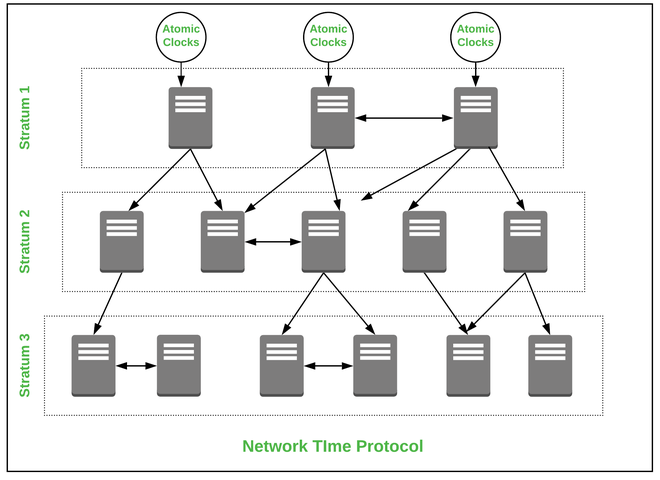
Stratum 0: These are the big guns. We’re talking atomic clocks and GPS satellites. They are incredibly accurate, but you can't connect to them directly over a network.
Stratum 1: These servers are physically plugged into Stratum 0 devices. They act as the primary timekeepers for the internet.
Stratum 2 and below: These servers get their time from Stratum 1. Your computer usually talks to a Stratum 2 or 3 server to update its clock.
Why it matters for AI and Data
If you're doing research or running big systems, "close enough" isn't good enough for time.
Log Files: If you’re debugging a crash across three different servers and their clocks are off by even a second, you’ll never figure out the sequence of events.
Security: Security systems like Kerberos won't let you log in if your clock is too far out of sync. It’s a defense against "replay attacks."
Distributed Training: When training large models across multiple GPUs or nodes, timestamps are used to coordinate data. If one node thinks it's a different time, the whole process can break.
The downside
NTP is great, but it isn't perfect.
If the server you’re syncing with goes down, your clock starts to "drift." Eventually, your device will lose accuracy. Also, since NTP packets travel over the open internet, network congestion can cause delays. This makes the time sync slightly less precise than it would be on a local, high-speed network.
There's also the risk of "time manipulation." If someone hacks an NTP server, they can trick your system into thinking it’s a different day entirely, which can bypass expiration dates on security certificates.
Here’s the thing
NTP is one of those invisible technologies. You don’t notice it until it stops working. But for anyone building distributed systems or doing serious research, keeping your clocks tight is one of the first things you should check.